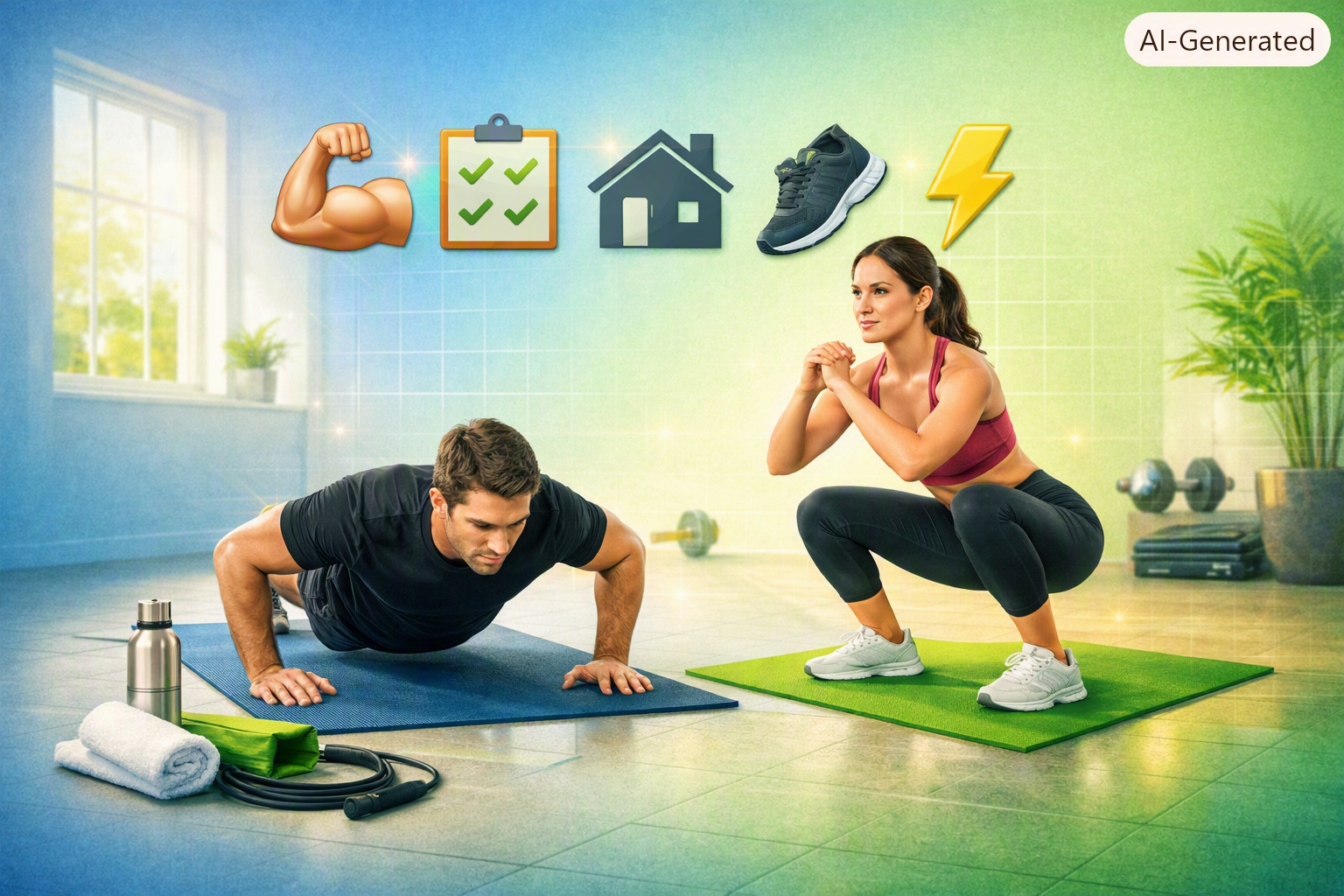
7 Best Bodyweight Exercises for Beginners to Master (Build Real Strength at Home)
You don’t need a gym membership or heavy weights to build a strong, capable body. Bodyweight training is the foundation of functional fitness, and mastering the right moves early on sets you up for long-term success. Choose the wrong exercises too soon and you risk frustration or injury. Choose the right ones and you’ll build strength, mobility, and confidence—right at home.
This guide covers the seven best beginner-friendly bodyweight exercises ranked for safety, scalability, and real-world carryover. You’ll also find a simple starter routine and a buying guide for gear that makes training more comfortable.
Why Bodyweight Exercises Work for Beginners
Bodyweight training lets you adjust intensity using leverage, range of motion, and tempo—no equipment required. This reduces injury risk while still building strength and endurance. Research shows that bodyweight movements like squats and push-ups can activate muscles similarly to weighted versions when performed with proper form.
The 7 Best Bodyweight Exercises for Beginners
1. Incline Push-Up (Beginner-Friendly Upper Body Strength)
Pitch: Before dropping to the floor, start with incline push-ups. They reduce wrist and shoulder strain while teaching proper pushing mechanics.
Key Features: Adjustable difficulty, core engagement, low joint stress.
Pros: Safe for wrists, easy to scale, teaches proper shoulder movement.
Cons: Less activation than floor push-ups; requires a sturdy surface.
Final Take: The best beginner upper-body move—gentle, scalable, and effective.
2. Bodyweight Squat (Essential Lower Body Strength)
Pitch: Squats mimic everyday movement patterns. Mastering them builds leg strength, hip mobility, and core stability.
Key Features: Targets quads, glutes, hamstrings; adjustable depth and tempo.
Pros: Zero equipment, improves daily movement, builds ankle mobility.
Cons: Hard to progress without variations; mobility limitations for some.
Final Take: The most important lower-body exercise for beginners.
3. Glute Bridge (Posterior Chain Power)
Pitch: Weak glutes contribute to back pain and poor posture. Glute bridges strengthen your posterior chain safely.
Key Features: Easy activation, scalable to single-leg variations.
Pros: Great for back health, low injury risk, beginner-friendly.
Cons: Limited range of motion; may feel “too easy” at first.
Final Take: Essential for building stronger hips and improving future lifts.
4. Plank (Core Stability Foundation)
Pitch: Planks build full-core endurance without stressing your spine.
Key Features: Isometric hold, scalable by duration or variation.
Pros: Safe, improves posture, strengthens shoulders and glutes.
Cons: Can feel repetitive; doesn’t build visible abs quickly.
Final Take: A 30-second plank with good form builds a strong foundation.
5. Bird-Dog (Balance and Anti-Rotation Strength)
Pitch: This physical-therapy favorite improves stability, coordination, and core control.
Key Features: Opposite arm/leg extension, slow controlled movement.
Pros: Low impact, fixes asymmetries, improves balance.
Cons: Feels awkward initially; requires shoulder stability.
Final Take: Mastering bird-dog improves every other core exercise.
6. Negative Pull-Up or Band-Assisted Pull-Up (Beginner Back Strength)
Pitch: Full pull-ups are tough. Start with negatives or band-assisted versions to build strength safely.
Key Features: Teaches pull-up mechanics, scalable resistance.
Pros: Builds lats and biceps, teaches timing, highly scalable.
Cons: Requires a bar; bands can snap if low quality.
Final Take: The smartest way to build pull-up strength from zero.
7. Walking Lunge (Unilateral Strength and Balance)
Pitch: Lunges fix imbalances and improve stride mechanics.
Key Features: Alternating steps, targets quads, glutes, hamstrings.
Pros: Strengthens stabilizers, improves balance, easy to progress.
Cons: Can stress knees if form is poor; requires space.
Final Take: The perfect next step after mastering squats.
How to Build Your First Bodyweight Routine
Start with three moves: one push, one pull, one lower-body. Practice three times per week.
Beginner Circuit
- Incline push-ups: 3×10 reps
- Bodyweight squats: 3×12 reps
- Plank: 3×20 seconds
- Glute bridges: 3×15 reps
Rest 2 minutes, then repeat once more. Progress weekly by adding reps or time.
Buying Guide: Gear to Support Bodyweight Training
Pull-Up Bars
Recommended: Perfect Fitness Multi-Gym Doorway Pull-Up Bar
Pros: No-screw design, supports up to 300 lbs.
Cons: May scratch door frames.
Resistance Bands
Recommended: WODFitters Resistance Band Set
Pros: Durable latex, multiple resistance levels.
Cons: Can roll during lower-body moves.
Exercise Mat
Recommended: Gaiam Extra-Thick Exercise Mat
Pros: Cushioned for core work.
Cons: Can get slippery when sweaty.
Push-Up Bars (Optional)
Recommended: StayFIT Push-Up Bars
Pros: Wrist relief, deeper range of motion.
Cons: Less stable for beginners.
Common Mistakes Beginners Make
- Moving too fast—slow reps build better form.
- Skipping mobility—tight hips limit squat depth.
- Ignoring core engagement—protects your lower back.
- Not resting—muscles grow during recovery.
When to Move On to Weighted Exercises
You’re ready for weights when you can do:
- 3×15 bodyweight squats
- 3×12 incline push-ups
- 60-second plank
At that point, consider a weighted vest or adjustable dumbbells.
Final Thoughts
Bodyweight exercises are the smartest entry point to fitness. Start with three moves, practice consistently for two weeks, and watch your strength and confidence grow. The only bad workout is the one you skip—so start with a single squat today.
Affiliate Disclosure: This page may contain affiliate links. We may earn a commission at no extra cost to you.